CARACAS, VENEZUELA (By Chevron, 3.Sep.2026, Words: 553) — Government representatives and business leaders gathered in Caracas as Chevron and its partners finalized agreements that support future energy development in Venezuela.
Among them was Mike Wirth, Chevron’s chairman and CEO, who joined the event as the company looks to build on more than a century of operating experience in the country.
The gathering brought a long-standing question into focus: Can one of the world’s largest oil reserves attract the investment needed to support long-term development?
For years, regulatory uncertainty and restrictive investment terms made many projects difficult to justify, leaving significant resources undeveloped.
Chevron believes that recent reforms and updated agreements have changed that equation, creating a stronger foundation for investment in a region where the company has operated for more than a century.
A new chapter for familiar fields
For years, Venezuela’s vast oil reserves have attracted attention, but development faced risks. Today, new terms are opening the door to future investment.
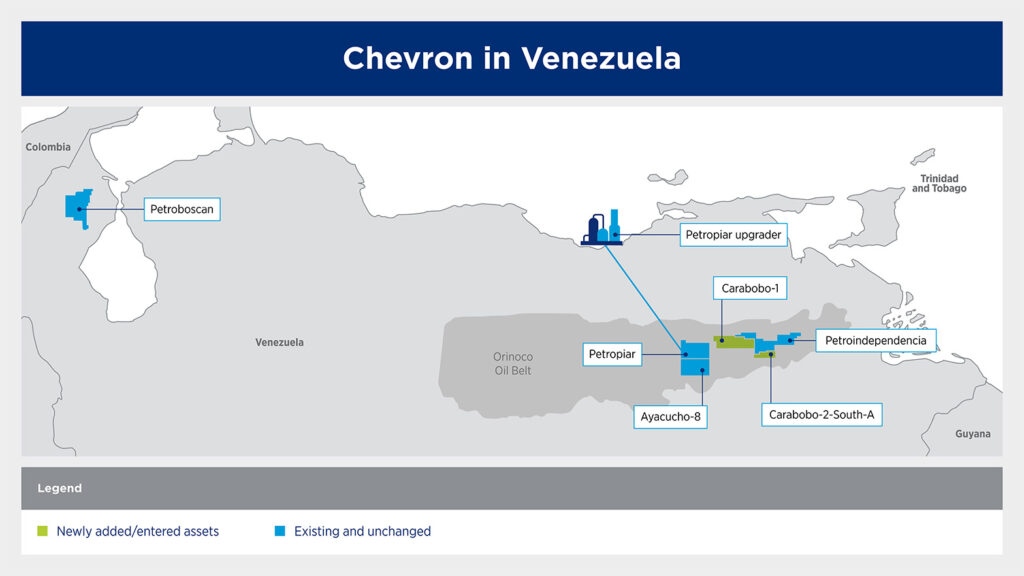
Venezuela updated its hydrocarbons law to attract private investment and expand participation in the energy sector, while Chevron and its Venezuelan partners signed agreements that update joint-venture terms and expand development rights in the Orinoco Belt—including the Carabobo-1 and Carabobo-2-South-A blocks.
The agreements reflect Chevron’s disciplined approach to developing the country’s resources, underscoring the strength of long-standing partnerships and the employees whose work continues to advance Venezuela’s energy potential.
Building on experience
Chevron’s presence in Venezuela dates to 1923. The company recently increased its ownership stake in Petroindependencia, one of its key heavy-oil joint ventures in the Orinoco Belt, to 49%. After adding Ayacucho 8 earlier this year, the company is now acquiring additional acres in the Orinoco Belt. Together, those assets strengthen Chevron’s position in a region where the company already operates infrastructure, produces oil and brings decades of experience.
Chevron’s three joint ventures have grown production by 15% year-to-date. The new agreements position Chevron to evaluate additional opportunities in an area where the company already has a deep operating presence.
What happens next
The agreements create a path for future investment, but many years of work remain. Chevron plans to continue evaluating opportunities within its existing operations while advancing development plans for newly assigned areas. Long-term growth will depend on continued reforms and collaboration on infrastructure improvements among industry and government partners.
For the leaders gathered in Caracas, the meeting marked the beginning of a new chapter. The agreements bring together vast resources, decades of operating experience and a stronger foundation for investment. As development moves forward, Chevron and its partners will focus on turning that foundation into long-term growth in the years ahead.
“We appreciate the leadership of the Administration, particularly the US Department of Energy and Secretary Wright’s partnership, in helping facilitate the conditions for further investment and growth,” said Wirth. “Continued engagement between government and industry is essential to advancing projects that support energy security, economic growth and continued investment.”
Key facts
- Chevron and Venezuela signed agreements that update joint-venture terms and expand development rights in the Orinoco Belt.
- Chevron has had a presence in Venezuela since 1923.
- Chevron’s Venezuelan joint ventures have increased production by 15% year-to-date.
- The joint ventures plan to invest more than $7bn over the next five years, more than doubling production to approximately 600,000 barrels a day, compared to 2026.
____________________