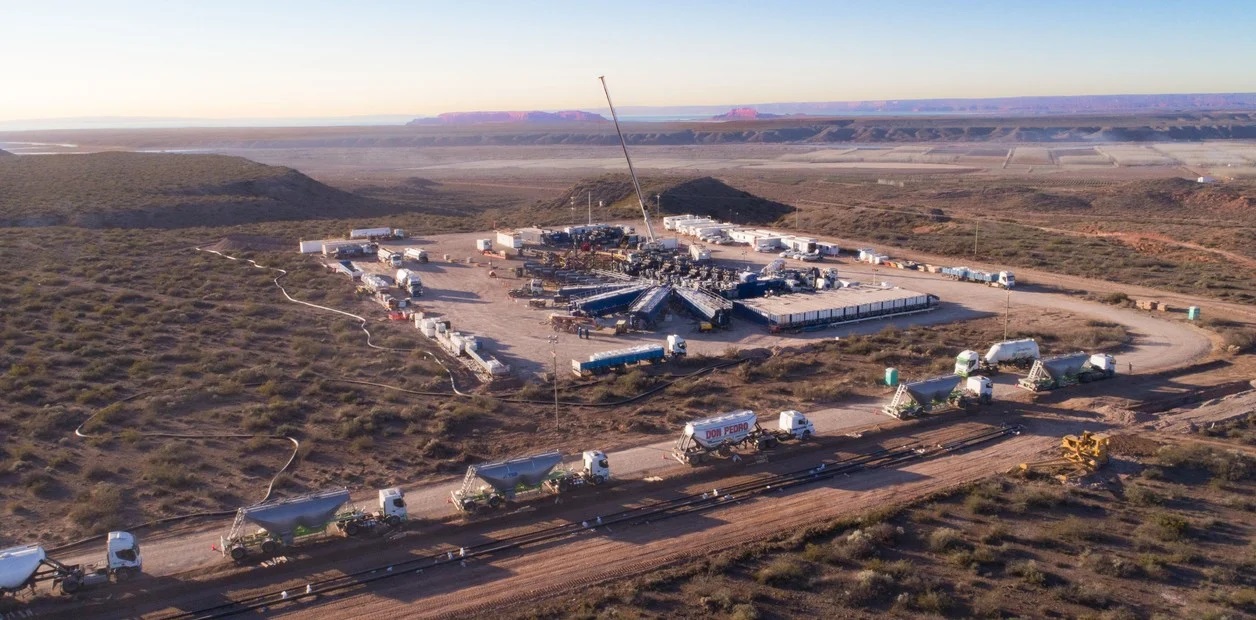
VANCOUVER, BC (By Blue Sky, 18.Aug.2026, Words: 1520) — Blue Sky Uranium Corp. and its joint-venture operating company, Ivana Minerales S.A. (IMSA), announced a new exploration program at the company’s Amarillo Grande Uranium-Vanadium Project in Río Negro Province, Argentina.
The initial program will include:
• first drill program at the Cuatro target comprised of 500 metres of reverse circulation (RC) drilling;
• detailed surface exploration along 5km of the corridor that extends from the Ivana Deposit through the Ivana Gateway target to the Ivana Central target, including 10 line-km of IP geophysical surveys, a Radon gas survey and lead-isotope geochemical sampling; and,
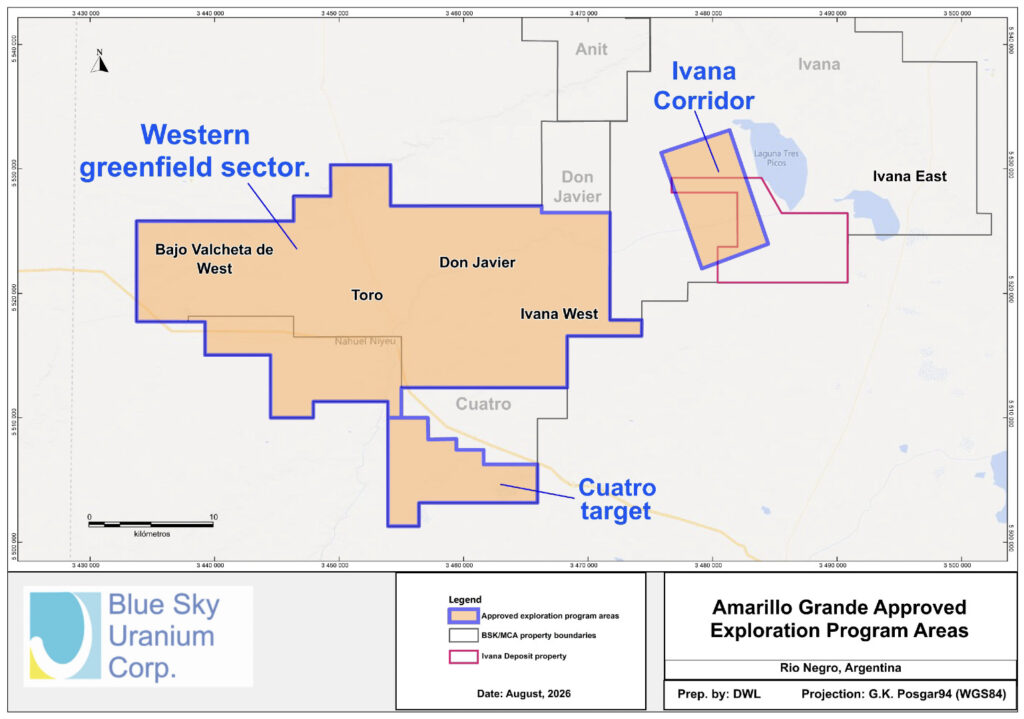
• regional greenfield exploration at the western targets Don Javier, Toro, Bajo de Valcheta West and Ivana West (see Figure 1).
Nikolaos Cacos, Blue Sky President & CEO commented, “This program allows us to simultaneously advance three complementary exploration opportunities at Amarillo Grande. Cuatro is our latest drill-ready target with discovery potential for the project. The Ivana Corridor, extending north from the Ivana deposit, is where we are going to employ new techniques to identify and map out targets and build on previous work in this large area. At the same time, regional exploration in the western sector will continue evaluating the broader district potential for new deposits. The staged approach allows us to advance the project efficiently and maximize chances of success.”
Blue Sky has scheduled exploration activities to take place over a twelve-month period. The approved and funded initial six-month program described above will also include permitting, contracting and field preparation. Following completion and interpretation of the initial work, subsequent IP surveys, plus additional RC and dual RC/diamond drilling at Cuatro and Ivana Gateway will be considered based on the results and joint technical review.
These targets are located on concessions held by Blue Sky via its 100% owned subsidiary, Minera Cielo Azul S.A. (MCA). This program is funded by joint venture partner Abatare Spain, S.L.U. (COAM) through IMSA, (the joint venture company (JVCO) established to advance the Ivana Uranium-Vanadium Project) pursuant to the call option agreement as reported on 27 Feb. 2025.
Program Details
Cuatro RC Drilling Program
Cuatro is the most advanced exploration target being tested by this program. The initial program includes 23 priority RC drill holes totaling approximately 500 metres, with an average planned depth of approximately 21m (see Figure 2).
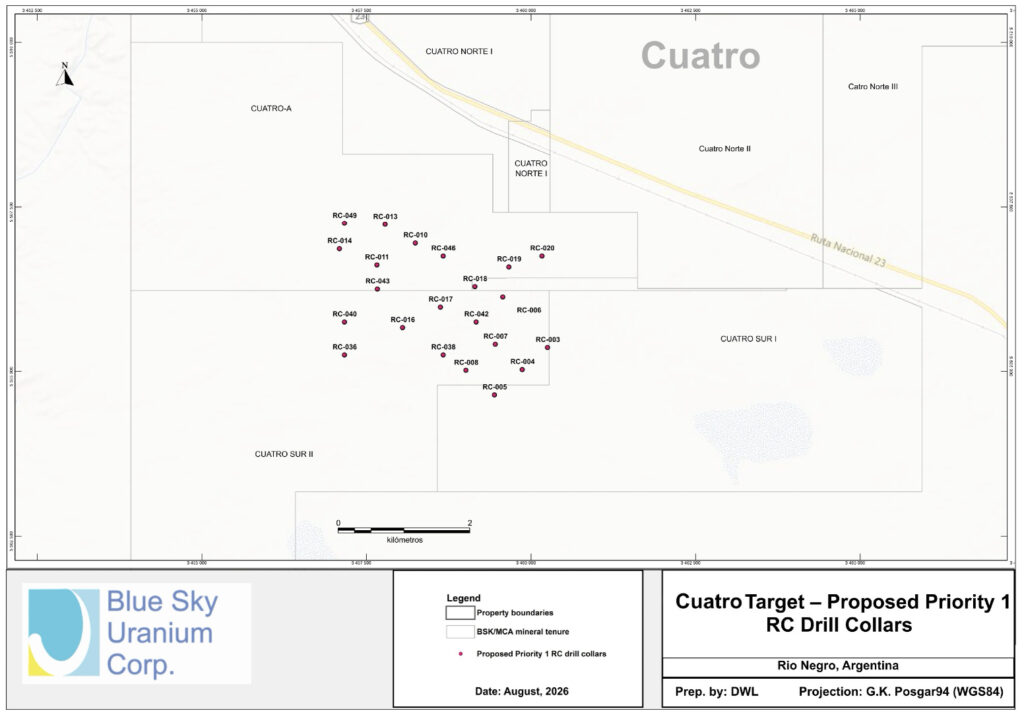
Drill collars were selected based on the coincidence of radiometric anomalies, shallow auger results, prospective geological interpretation and historical hydrogeochemical sampling, which returned a highly anomalous uranium concentration of 2,590 µg/L U, together with 191 µg/L V, from water collected from a local shallow hand-dug well. The program is intended to evaluate the continuity and geological significance of these anomalies.
Depending on the results of the initial campaign, a second phase of approximately 30 additional drill holes totaling approximately 500 metres may be executed.
Ivana Corridor Surface Exploration
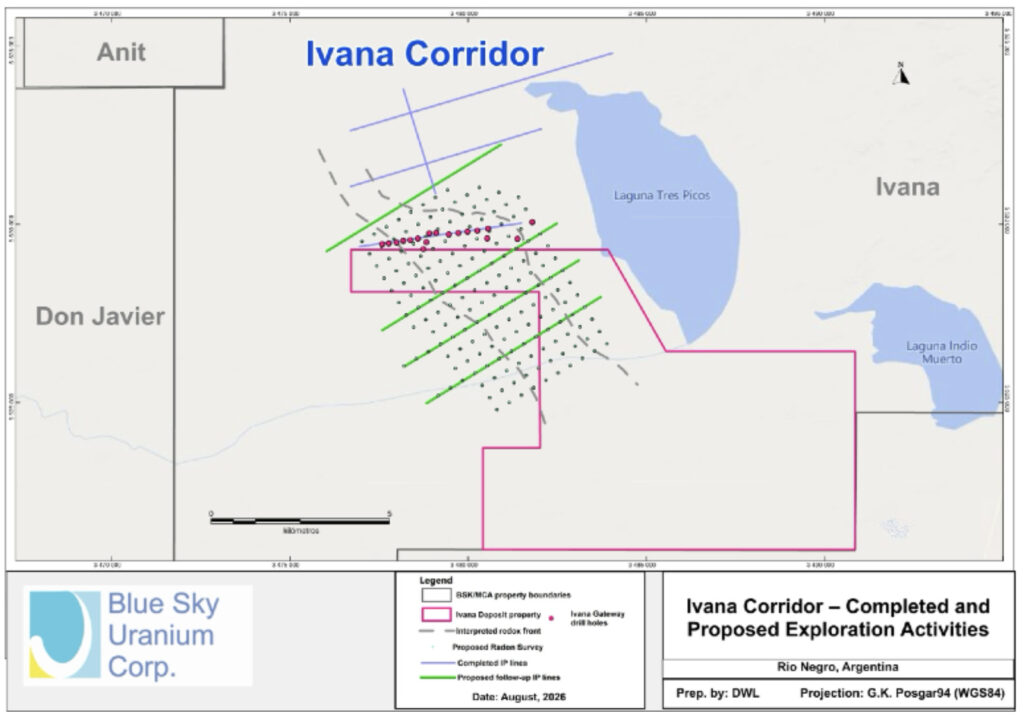
The Ivana Corridor extends approximately 11 km from the Ivana Deposit through the Ivana Gateway target toward the Ivana Central target (see Figure 3). The current exploration program will evaluate 5 km of this broader corridor, which represents a priority brownfield exploration area within the district-scale redox-front uranium model developed at Amarillo Grande.
The recent diamond drill program at Ivana Gateway identified multiple reduced sandstone horizons associated with organic matter, pyrite, anomalous uranium geochemistry and favorable redox-front alteration. Reported results from Phase 1 of the program included 3.4 m averaging 272 ppm U₃O₈, starting at 54m in drill hole AGIG-007. Phase 2 of the program was comprised of six holes totaling 392 m across the western portion of the target. Drill hole AGIG-013 intercept 1.6m averaging 36 ppm U₃O₈ starting at 19.5 m and 2 m averaging 33 ppm U₃O₈ from 45.0 m. The remaining 5 holes did not return additional significant uranium mineralization, however, the holes completed the planned drill coverage and helped define the western extent of the system (see details below).
In this program, the first phase of work in the Ivana Corridor will focus on improving the definition of prospective portions of the corridor. The program is expected to begin with a radon gas pilot survey using passive alpha-track emanometry (DTPA) over a covered portion of the Ivana Deposit, where the method can be evaluated under known geological and mineralization conditions. This exploration tool places detectors in shallow holes to detect radon gas from buried deposits over a period of weeks. The method has the potential to detect deeper mineralization than traditional surface gamma-ray scintillometers, while reducing “noise” from weather or other conditions that may affect other methods. The pilot survey is planned to include approximately 12 to 18 stations on an initial 200-by-200-m grid. Subject to validation of the method, DTPA coverage may be extended along the Ivana Corridor and integrated with approximately 10 kilometres of new IP surveying and new lead-isotope sampling to be completed, as well as compiled geological information and previous drilling results.
The objective of this work along the Ivana Corridor is to identify coherent anomalies that may provide additional support for subsequent exploration stages. Follow-up IP geophysics, shallow auger drilling and up to 1,500m of RC or dual RC/diamond drilling may be considered following the integration and technical evaluation of the initial results.
Western Greenfield Exploration
The western component of the program is intended to improve the geological understanding of Don Javier, Toro, Bajo de Valcheta West and Ivana West and to generate new exploration targets at the district scale, to the west of the Ivana deposit property (see Figure 1).
Activities are expected to include the integration of historical information, geological mapping, ground radiometric surveying, surface geochemistry, trenching, lead-isotope studies, emanometry and shallow auger drilling.
The results will be evaluated progressively to identify and prioritize areas that may justify more detailed geophysical surveys or future drilling.
Ivana East Program Update
The company has completed its previously announced drill program at the Ivana East target. Six diamond drill holes totaling 431m were completed. The drilling did not confirm the geological and geophysical model originally proposed for the target. The holes mainly intersected thick, fine-grained clay-rich units attributed to the Gran Bajo del Gualicho Formation, with only minor sandstone intervals. The favourable sandstone facies of the lower Chichinales Formation, which hosts the uranium mineralization at Ivana, were not identified in the tested locations. Uranium and vanadium mineralization was discontinuous, and assays were below the Company’s reporting threshold. Future work at Ivana East will require revising the geological model to better understand the potential for favourable uranium-hosting sandstone units.
The diamond drilling program was carried out by AGV Falcon Drilling. Core is logged, photographed, and geologically described. Mineralized intervals are identified based on lithology, alteration, and radiometric response, where applicable. Sample intervals are determined by geological boundaries and typically range from approximately 0.15 to 1.5m in length.
Samples were sent to ALS in Mendoza, Argentina for preparation by drying, crushing to 70% <2mm, riffle splitter 250g and pulverize to 85% <75 µm. Pulps were sent to ALS in Lima, Peru for analysis of multi-elements ultra-trace method combining four acid digestion with Inductively Coupled Plasma (ICP) instrumentation. Digestion is performed on 0.25g of sample to quantitatively dissolve most geological materials. Analytical analysis is performed with combinations of ICP-AES (Atomic Emission Spectrometry) & ICP-MS (Mass Spectrometry). Approximately every 10th sample, blank, duplicate, or standard samples were inserted into the sample sequence for quality assurance/quality control (QA/QC). The internal assessment of the QA/QC data for the exploration program determined that the analytical results reported herein are within standard industry limits.
| Hole ID | Easting | Northing | Elevation (m) | Hole length (m) | From (m) | To (m) | Interval (m) | U₃O₈ (ppm) | V (ppm) |
| AGIG-013 | 3478588 | 5529620 | 85.49 | 66 | 19.5 | 21.1 | 1.6 | 36 | 31 |
| 45 | 47 | 2 | 33 | 44 | |||||
| AGIG-014 | 3,478,373 | 5,529,580 | 90.2 | 60 | No significant intervals | ||||
| AGIG-015 | 3,478,178 | 5,529,560 | 86.71 | 80 | No significant intervals | ||||
| AGIG-016 | 3,477,988 | 5,529,511 | 87.63 | 63 | No significant intervals | ||||
| AGIG-017 | 3,477,769 | 5,529,489 | 87.35 | 60 | No significant intervals | ||||
| AGIG-018 | 3,477,587 | 5,529,468 | 90 | 63 | No significant intervals | ||||
| *All holes were drilled vertical, and the reported intervals are believed to represent true thickness |
The diamond drilling program was carried out by AGV Falcon Drilling. Core is logged, photographed, and geologically described. Mineralized intervals are identified based on lithology, alteration, and radiometric response, where applicable. Sample intervals are determined by geological boundaries and typically range from approximately 0.15 to 1.5m in length.
Samples were sent to ALS in Mendoza, Argentina for preparation by drying, crushing to 70% <2mm, riffle splitter 250g and pulverize to 85% <75 µm. Pulps were sent to ALS in Lima, Peru for analysis of multi-elements ultra-trace method combining four acid digestion with Inductively Coupled Plasma (ICP) instrumentation. Digestion is performed on 0.25g of sample to quantitatively dissolve most geological materials. Analytical analysis is performed with combinations of ICP-AES (Atomic Emission Spectrometry) & ICP-MS (Mass Spectrometry). Approximately every 10th sample, blank, duplicate, or standard samples were inserted into the sample sequence for quality assurance/quality control (QA/QC). The internal assessment of the QA/QC data for the exploration program determined that the analytical results reported herein are within standard industry limits.
____________________