TORONTO, CANADA (By Jaguar Uranium, 13.Oct. 2026, Words: 534) — Jaguar Uranium Corp. announced an independent mineral resource estimate (“MRE” or “mineral resource estimate”) for its 100%-owned flagship Laguna Salada uranium-vanadium project, located in Chubut Province, Argentina.
The MRE was prepared in accordance with the disclosure requirements of Subpart 1300 of Regulation S-K of the US Securities and Exchange Commission (SEC) and national instrument 43-101 – standards of disclosure for mineral projects (“NI 43-101”). The MRE was prepared by independent geological consulting firms Caracle Creek Chile SpA and Atticus Geoscience Consulting Ltd., with an effective date of 5 Oct. 2026. All dollar values are in USD.
Location, Geology and Mineralization
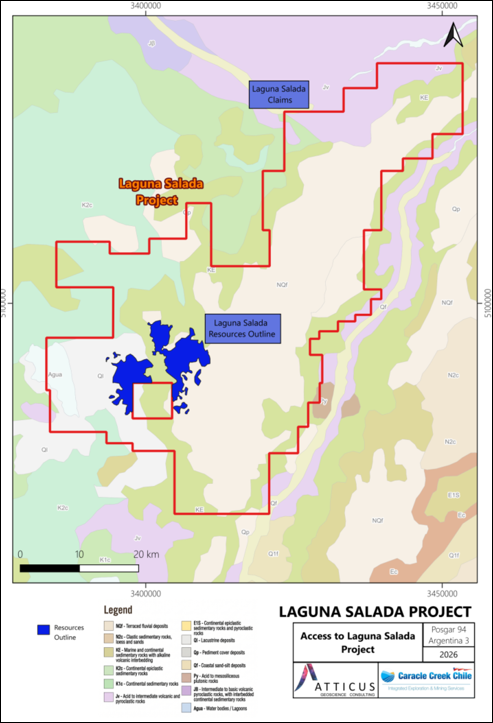
The Laguna Salada deposit is a district-scale, near-surface, surficial uranium-vanadium asset covering 28 mining concessions over 210,284.45 hectares in central Patagonia (Figure 1).
Mineralization occurs as shallow, tabular, caliche-style gravels and unconformity-hosted zones that could be amenable to low-cost open-pit extraction and physical beneficiation. The potential mining and processing methods, costs, environmental effects and economic viability of the Mineral Resources have not been established and will require further technical studies.
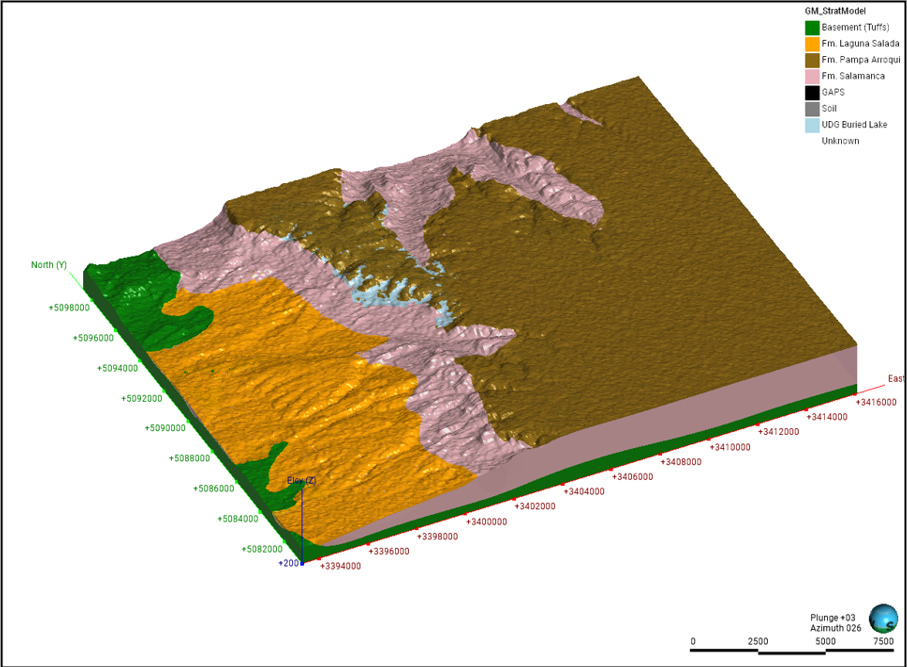
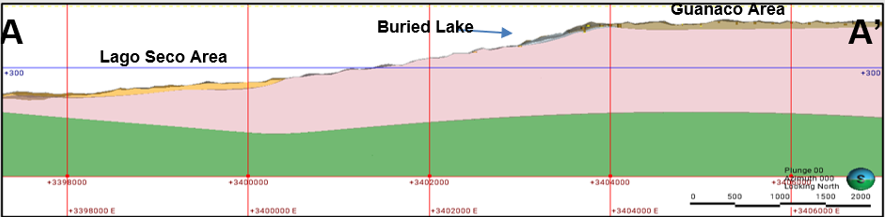
Uranium-vanadium mineralization at Laguna Salada occurs in unconsolidated gravels of the Pampa de Arroqui formation, in unconsolidated gravels of the Gran Laguna Salada formation, and near the unconformity between Quaternary strata and the underlying substratum, including sandstones and pelite of the Salamanca formation and sandstones and conglomerates of the Puesto Manuel Arce Formation (Figure 2).
The principal uranium-vanadium mineral recognized at Laguna Salada is carnotite, which commonly occurs as yellow-green powdery or finely crystalline material within the sandy matrix of the gravel, as partial rims on sand grains and clasts, and locally as staining within carbonate-cemented matrix material.
Three principal styles of uranium-vanadium mineralization are recognized on the Project: near-surface, tabular, caliche-style uranium-vanadium mineralization in unconsolidated sandy gravel at Guanaco and Lago Seco; unconformity-related uranium-vanadium mineralization at Buried Lake; and volcanic-hosted uranium-vanadium mineralization at La Rosada.
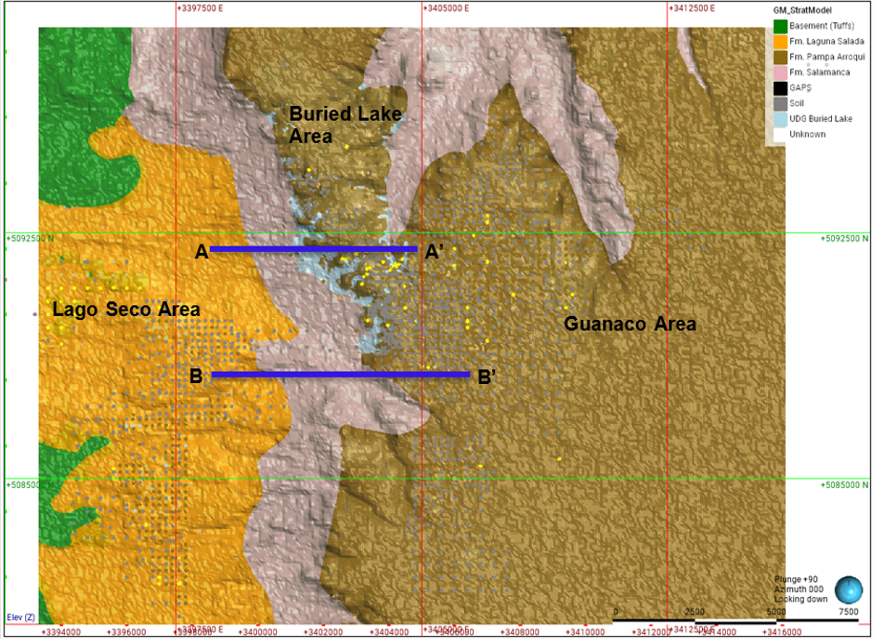
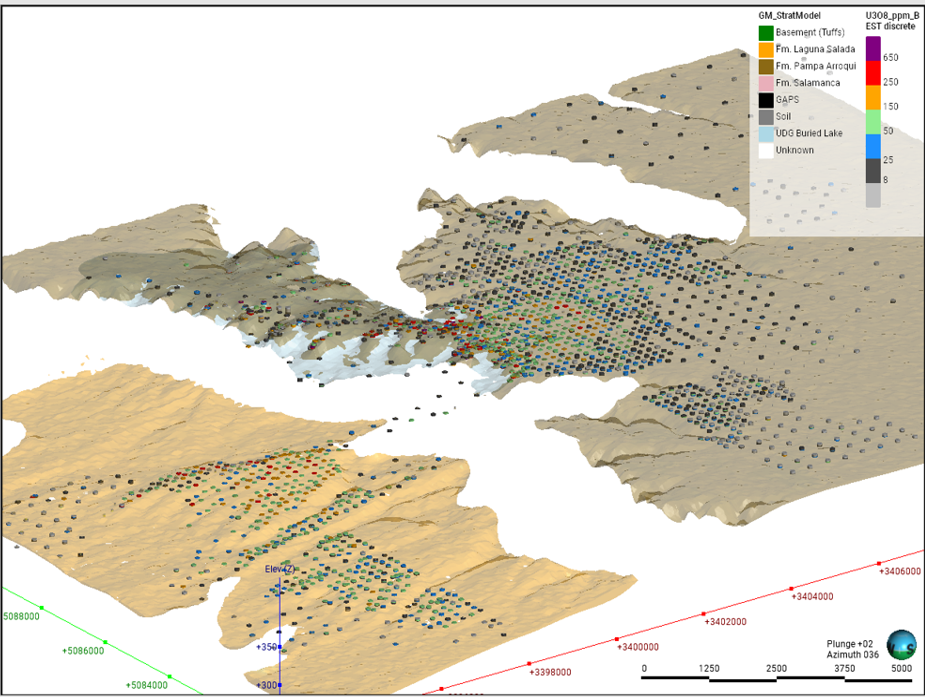
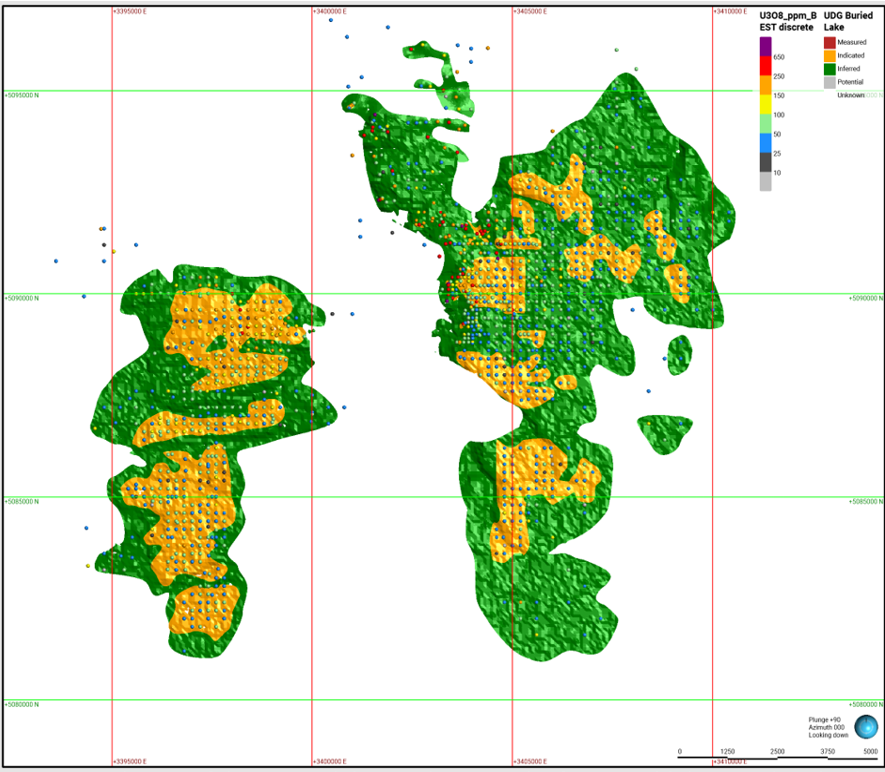
The principal mineral resource areas are Laguna Salada, historically referred to as Lago Seco, Pampa de Arroqui, historically referred to as Guanaco, and Buried Lake (Figure 3 and Figure 4).
Upcoming Work Program
Jaguar is targeting a work program designed to upgrade Inferred resources and expand mineralization across open target areas:
- Pampa de Arroqui & Laguna Salada Infill: Excavation of approximately 250 new surface pits and trenches to achieve 200m to 100m grid coverage.
- Buried Lake Sonic Drilling: Completion of 1,500m of sonic/vibrosonic drilling (about 100–150 drill holes) to recover intact, representative core across the unconformity-hosted domain.
- Metallurgical & Field Studies: Representative sampling for bench-scale beneficiation/vanadium recovery optimization, environmental baseline monitoring, and updated MRE modeling.
“The completion of this independent Regulation S-K 1300 compliant Mineral Resource Estimate marks a landmark milestone for Jaguar Uranium as we quantify the significant scale of Laguna Salada with this resource estimate representing only about 4% of the total Project area,” said Steven Gold, Chief Executive Officer of Jaguar Uranium Corp. “Laguna Salada represents one of the largest potential undeveloped surficial uranium-vanadium deposits in South America, at a time of growing political support for new Western sources of critical and energy metals. Its favorable beneficiation characteristics may allow us to upgrade the raw gravel into a high-grade fine fraction, potentially supporting an efficient, low-impact development pathway in an established mining region.”
____________________