MEXICO CITY, MEXICO (By S&P Global Ratings, 12.May.2026, Words: 2016) — S&P Global Ratings revised its outlook on the long-term ratings on Mexico to negative from stable. We affirmed the ‘BBB’ long-term foreign currency and ‘BBB+’ long-term local currency sovereign credit ratings on Mexico. We also affirmed our ‘A-2’ short-term ratings on the country. Our transfer and convertibility (T&C) assessment is unchanged at ‘A’.
Outlook
The negative outlook reflects the risk of very slow fiscal consolidation largely due to low economic growth resulting in a faster-than-expected buildup in government debt levels and higher interest burden. The expected continued substantial fiscal support for Petroleos Mexicanos (Pemex) and Comision Federal de Electricidad (CFE) would continue to aggravate Mexico’s fiscal rigidities. An unexpected worsening of Mexico’s close trade and other economic links with the U.S. could also weaken the country’s solid external position.
Downside scenario
In the next 24 months, we could downgrade Mexico if it fails to reduce its fiscal deficits in a timely manner that stabilizes and contains the government’s debt, interest burden and contingent liabilities. We could also downgrade the sovereign if unexpected setbacks in trade and other economic ties with the U.S. undermine economic stability and weaken Mexico’s strong external position.
Upside scenario
We could revise the outlook to stable in the next 24 months if effective policy implementation translates into meaningful fiscal consolidation, helping to stabilize debt levels and the government’s interest burden. A pickup in private-sector investment levels that bolsters economic growth could strengthen the country’s economic resilience and help stabilize public finances.
Rationale
Our ratings on Mexico reflect its institutional framework that has fostered political stability and regular changes of government for more than two decades, as well as cautious fiscal and monetary policies supported by a floating exchange-rate regime. Many years of prudent monetary policy and growing domestic capital markets have strengthened the country’s monetary flexibility. These factors have maintained investor confidence and the sovereign’s access to global capital markets. The credibility of the independent central bank and its ability to pursue an inflation-targeting monetary policy play prominent roles in our analysis, as does Mexico’s solid external position.
Mexico’s relatively low per capita economic growth is a key rating constraint. Soft economic growth, intensifying spending rigidities, and the weak financial position of Mexico’s largest public-sector companies weaken fiscal flexibility and raise debt levels.
Institutional and economic profile: Institutional and political stability has not translated into faster economic growth
- The rating reflects Mexico’s free-floating currency, independent central bank, trade openness, and smooth transition of political power.
- We expect pragmatism in the current negotiation of the United States-Mexico-Canada Agreement (USMCA) to result in stable trade flows among the three countries.
Mexican governments of various political parties in the past two and a half decades have largely pursued moderate fiscal and monetary policies and supported the free trade agreement with the U.S. and Canada. However, policy implementation has been for many years unsuccessful at tackling long-standing issues that result in low productivity and economic growth in Mexico, such as poor physical infrastructure, a large informal economy, low access to credit, low-quality education, and weak security conditions.
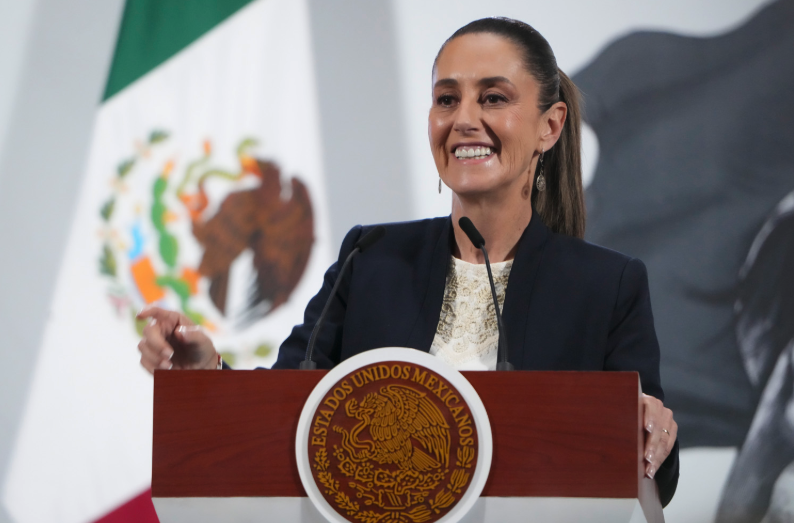
President Sheinbaum was elected in June 2024 and has enough support in both houses of Congress to pass constitutional amendments. The most significant constitutional reform undertaken by the current government was that of the judiciary that, among other things, introduced the election of federal judges.
In contrast to her predecessor, President Sheinbaum has shown greater openness toward the private sector to promote economic growth. Her administration announced Plan Mexico, a program designed to boost investment, employment, energy, and food self-sufficiency through targeted investments by the private and public sectors. Aligned with Plan Mexico, the government announced in February 2026 a MXN5.6 trillion (15% of GDP) infrastructure plan contemplating public, private, and mixed investments. The initiatives were well received by the domestic market, but there is uncertainty about financing mechanisms and the private sector’s role in the program, resulting in very slow implementation.
Security policy under President Sheinbaum has been more proactive, making greater use of intelligence and coordination among various domestic agencies and levels of government, as well as shared intelligence with the U.S. authorities. The new security policy has led to many arrests of drug cartel leaders recently, though recent events highlight the risks associated with weak security conditions in some parts of the country.
Negotiations with the U.S. over the future of the USMCA have been affected by nontrade issues, such as the flow of drugs into the U.S. and immigration. Rising U.S. concern about the ties between illegal drug organizations and various levels of government in Mexico have created new bilateral tensions. Recently, a U.S. federal court issued indictments against a sitting Mexican state governor, a federal senator, and other government officials for links with drug-trafficking organizations.
Mexico, the U.S., and Canada are under a formal process of technical negotiations of the USMCA. By July 1, 2026, they could extend the agreement for another 16 years (even with some chapters still under review). If there is no agreement by that date, the countries could switch to annual reviews until an agreement is reached. At any point, any of the countries could withdraw unilaterally after a six-month notice. The current key points of the negotiation are to strengthen the origin rules and regional supply chains, reducing the block’s exposure to China’s manufacture inputs, and review Mexico’s energy market rules. We assume that Mexico will continue to have good access to the U.S. market, more favorable than for most countries, despite trade tensions.
Given a slowdown in consumption and contraction in private-sector investment, Mexico’s GDP growth has slowed to 0.8% in 2025 from 1.1% in 2024 and 3.3% in 2023. During the first quarter of 2026, the economy only grew 0.2% in annual terms. A challenging external environment, given a marked surge in energy prices and USMCA renegotiation uncertainty, combined with a private sector hesitant to invest more, will likely result in 1% GDP growth in 2026. As uncertainty fades and monetary policy resumes an easing stance, we expect growth to trend toward 2%, a weaker pace than those of peers. We expect GDP per capita at US$15,727 in 2026.
Flexibility and performance profile: Weakening financial flexibility contrasts with still strong external position
- Weaker fiscal flexibility would hinder fiscal consolidation.
- The composition of Mexico’s sovereign debt limits market and interest rate risk.
- The sovereign’s solid external position is based on the Mexican peso’s status as an actively traded currency and the country’s moderate external debt.
The general government deficit in 2025 stood at 4.9% of GDP, compared with 5.2% in 2024, and the 2.7% average between 2019 and 2023. General government revenue has been edging up since 2022. Therefore, the moderately large fiscal deficits stem from rising spending (including on welfare) and interest burden, as well as materializing contingent liabilities from Mexico’s public-sector companies, especially Pemex. Despite additional fiscal pressures to finalize flagship infrastructure programs from the previous administration, the government’s investment in physical assets was only 1.9% of GDP in 2024 and 1.4% in 2025, compared with 1.7% on average in the prior 10 years.
Amid a weak economy and the government’s efforts to stabilize fuel prices through forgone taxes, we expect Mexico’s general government deficit at 4.8% of GPD in 2026. As the economy recovers and the energy shock normalizes, we expect Mexico’s budgetary constraints to result in a very gradual fiscal consolidation, with fiscal deficit averaging 4.2% of GDP for the forecast period.
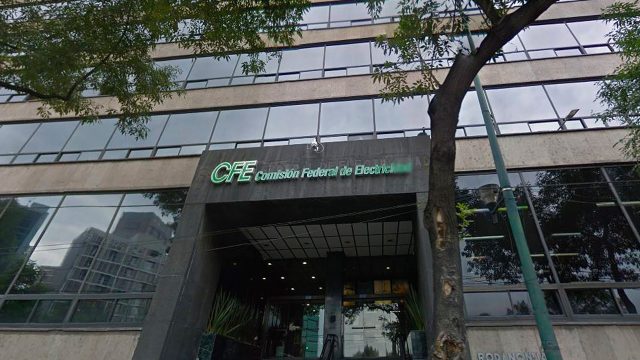
Our forecast assumes that all of Pemex’s debt amortizations will be financed by central government transfers. However, poor operational results at Pemex could prompt the government to provide more funds to cover future financial losses, widening the fiscal deficit. Moreover, we will continue to monitor the potential impact of the government’s ambitious infrastructure plans on Mexico’s deficits and debt trajectory. The sovereign does not formally guarantee the debt of Pemex or CFE. But we continue to view the likelihood of the sovereign providing extraordinary support to both entities as almost certain, as was the case recently. As such, we rate Pemex and CFE at the same level as the sovereign, despite their weaker stand-alone credit profiles. Contingent liabilities have materialized over the recent past, but we continue to view the associated contingent liabilities from both entities as limited.
We expect Mexico’s net general government debt to rise by an annual average of 4.4% of GDP in 2026-2029. We forecast net general government debt to rise to about 54% of GDP by 2029 from 49% in 2025. We expect interest payments, as a share of general government revenue, to decrease from recent peak but to average marginally higher than 15% during the forecast period.
The composition of Mexico’s sovereign debt limits market and interest rate risk. Nearly 85% of it is issued domestically in pesos, most of which is at fixed rates. Mexican private pension funds (Afores) are the largest holders of the Mexican government debt, and with other domestic institutional investors, are likely to remain stable and regular creditors of the sovereign. This trend is likely to be reinforced by the projected growth of Afores’ assets under management following the 2024 pension reform.
Contingent liabilities from the financial sector are also limited. Mexico’s financial system remains well capitalized and highly liquid. Long-standing conservative lending practices will act as a buffer amid tough economic conditions. As of February 2026, nonperforming assets (that include past-due loans of more than 90 days, plus foreclosed assets) represent about 2.45% of total loans and remain fully covered by loan-loss provisions. Foreign-owned banks disburse about 62% of total loans. We expect total credit to expand at about 9% in nominal terms in 2026. Domestic credit to the private sector and nonfinancial public-sector enterprises was at 28% of GDP in 2025.
Mexico’s solid external position, a rating strength, is based on the peso’s status as an actively traded currency and on the country’s low external debt. As Mexican exporters complied with USMCA rules of origin, effective tariff rates on Mexican exports have remained in low-single digits. Despite a contraction in automobile exports, those of computer components have surged, resulting in record-level exports to the U.S. in 2025. Mexico has been a net energy importer since 2015, and the current energy shock will likely marginally worsen Mexico’s trade deficit in 2026, but it will normalize by 2027 as energy prices trend down. A more restrictive immigration policy should reduce remittances from the nominal peak in 2024, but we still expect them to average 3% of Mexico’s GDP. We expect current account deficit at 0.7% of GDP during the forecast period, fully funded by net foreign direct investment inflows.
Our estimate of narrow net external debt (gross debt net of liquid external assets) averages 20% of current account receipts (CAR) through 2029. We include nonresident holdings of locally-issued debt in our estimates of external debt, because our methodology calculates external debt on a residency basis. The country’s gross external financing needs are likely to be about 87% of CAR and usable reserves. Mexico has access to a $24 billion flexible credit line from the IMF and a $9 billion swap line from the U.S. Treasury.
Inflation has remained below 10% since 1999. The central bank began cutting its policy interest rate in March 2024 from recent peak levels, reaching the neutral ground by the fourth quarter of 2025. Inflation expectations for the next 12 months are within the central bank’s tolerance range. We assume that weak economic activity will help enable headline inflation to fall back within the within the bank’s range of 2%-4% by the second half of 2027.
Mexico’s monetary flexibility has strengthened due to growing domestic capital markets and the central bank’s track record of proactive policies that have contributed to long-standing credibility, backed by a constitutional mandate to maintain stable, low rates of inflation. We assume the legal independence of the central bank and public support for the institution will result in continuity in prudent monetary policy. Mexico operates a free-floating currency, and the central bank has not intervened in the foreign exchange market since the pandemic.
____________________