MEXICO CITY, MEXICO (By Pietro D. Pitts, Energy Analytics Institute, 17.Dec.2024, Words: 2,164) — International oil companies (IOCs) in Mexico’s oil and gas sector have good reason to take a seemingly wait-and-see attitude. This, after Morena Party’s Claudia Sheinbaum Pardo won the country’s presidential elections earlier this year and as she prepares for her sexenio or six year term (2024-2030).

Sheinbaum has said during her daily manañera or conference with the media that she doesn’t believe in the “absolute privatization model.” She has also said her administration will continue with national and sovereign development plans for state-owned oil and gas company Petróleos Mexicanos (Pemex) and the Federal Electricity Commission (CFE).
Sheinbaum’s stance aligns with Mexico’s former President Andrés Manuel López Obrador (AMLO), who founded the Morena Party.
AMLO’s sexenio, from 2018-2024, was dominated by actions to fulfill his presidential campaign promise of a Fourth Transformation. Said transformation aimed to end corruption and reduce violence. It also aimed to boost economic growth, including expanding mega-infrastructure projects, while also supporting social programs aimed at reducing poverty and inequality. These programs were very popular with a majority of the Mexican population.
The election of Sheinbaum, a technocratic, translates into continuity of the AMLO’s Fourth Transformation. The other three transformations that AMLO always referred to during this presidential term include: the Mexican Revolution, the reforms of Benito Juárez and Mexico’s independence.
Sheinbaum’s approach is very likely to improve relations between the Mexican government and IOCs, although there is no expectation that bid rounds will resume nor that she will facilitate terms that will allow private players to have a higher participation in the market.
The most pressing issues for Sheinbaum, who assumed the presidency on 1 Oct. 2024, will be her ability to manage her relation with Donald Trump, once he assumes the presidency in the US on 20 Jan. 2025. Themes that will take the forefront of their discussions include: immigration, drug trade and the review of USMCA, formerly NAFTA, even though not until 2026.
Mexico’s former president Enrique Peña Nieto (2012-2018) launched the country’s historic energy reform, which opened the oil, gas and energy sectors to foreign investment. Both foreign and domestic players taunted the reform and opportunities. However, all that changed with the arrival of AMLO, who trumpeted instead for Mexico’s energy sovereignty including continued support for Mexico’s state-owned electrical utility Federal Electricity Commission (CFE) as well as Pemex.
AMLO’s nationalistic stance has worked to reverse Mexico’s short lived energy reform.
Heavily indebted Pemex is at the forefront of Mexico’s hydrocarbon sector. However, its production of liquids and condensates remains slightly below the 1.8 MMb/d mark. This compares to production slightly above 2 MMb/d in 2014.
Despite recent elections in Mexico and the US and the uncertainties around the future of the energy sectors in both country, a handful of IOCs remain entrenched in Mexico, and at least for now.
The bulk bracket IOCs include: Woodside Energy Ltd. (Australia), Harbour Energy plc (UK), which recently took over the E&P business of Wintershall Dea (Germany), and Eni SpA (Italy). Talos Energy (US) is another IOC, but on a smaller scale, but none the least entangled in a Zama “Drama” offshore Mexico.
These IOCs bring to the table strong balance sheets, know-how, especially in the nearshore and deep water regions, and international experience moving forward difficult projects. Their continued participation in Mexico hold potential to assist Pemex revert the long-term declining production trend.
Woodside, Trion and deepwater production

Woodside, after is game-changing merger with BHP Petroleum, has its eyes fixed on the Trion field offshore Mexico. Pemex found the field in 2012. BHP and Pemex later inked an agreement to develop the field in 2017.
Perth, Australia-based Woodside announced a $7.2bn final investment decision in Jun. 2023 to develop the large, high-quality Trion resource in Mexico. Woodside operates Trion with a 60% interest while Pemex’ upstream affiliate PEMEX Exploración y Producción (PEP) holds the remaining 40% interest. Of the total Capex, $4.8bn responds to Woodside share including capital carry of Pemex of $460mn with the development expected to deliver strong returns to Woodside shareholders as well as economic and social benefits to Mexico.
Trion represents Woodside’s first major investment decision following its merger with BHP.
The investment in Trion is expected to deliver an internal rate of return (IRR) greater than 16% with a payback period of less than 4 years. The forecast IRR excluding the capital carry is greater than 19%, according to Woodside. Trion will target the development of an estimated 479 MMboe of Best Estimate (2C) Contingent Resource (100%) of oil and gas (287 MMboe 2C Contingent Resources, Woodside net economic interest).
Trion is located in the Perdido Fold Belt in the Gulf of Mexico (GOM). The project is set in a water depth of 2,500m and located 180km off the Mexican coastline and 30km south of the US/Mexico maritime border. Trion, a greenfield development, will represent the first oil production to come from Mexico’s deepwater. Future discoveries have potential to be tied back to Trion facilities. Importantly, for Woodside, Trion represents the company’s fourth major project in the US/Mexico GOM. The first 3 projects are located on the US side of the maritime border and include Shenzi, Atlantis and Mad Dog.
The Trion subsurface has been extensively appraised, with 6 well penetrations undertaken across the field, informing Woodside’s understanding of this large, high-quality conventional resource.
A floating production unit (FPU) with a nameplate capacity of 100,000 b/d will be used to process Trion’s production. The FPU can process up to 120,000 b/d in the early producing years of the field with no water breakthrough, according to Woodside. Initial oil is expected in 2028. The FPU will be connected to a floating storage and offloading (FSO) vessel with a capacity of 950,000 barrels of oil, according to Woodside.
Trion will have an all-in breakeven below $50/bbl and then below $43/bbl, excluding the Pemex capital carry, according to Woodside. Trion is also expected to deliver an IRR that exceeds 16%. Excluding the Pemex capital carry, the IRR exceeds 19%.
Trion’s average carbon intensity is expected to average 11.8 kg CO2e/boe during the life of the field, which is lower than the global deepwater oil average.
Enter the Harbour-Wintershall Dea deal

As of 3 Sep. 2024, Wintershall Dea’s E&P business, excluding Russia-related activities, was transferred to Harbour Energy. This, after London-based Harbour announced an agreement on Dec. 21, 2023 to acquire substantially all of Wintershall Dea’s upstream oil and gas assets for $11.2bn.
The Wintershall Dea transfer to Harbour included production and development assets as well as exploration rights in Norway, Argentina, Germany, Mexico, Algeria, Libya (excluding Wintershall AG), Egypt and Denmark (excluding Ravn) as well as Wintershall Dea’s carbon storage (CCS) licenses.
Wintershall Dea’s remaining assets include stakes in the joint ventures in Russia, the ownership interest in Wintershall AG in Libya (Wintershall Dea share: 51%), in Wintershall Noordzee BV in the Netherlands (Wintershall Dea share: 50%) as well as the share in Nord Stream AG (Wintershall Dea share: 15.5%). The management of Wintershall Dea announced its withdrawal from activities in Russia in Jan. 2023.
Wintershall Dea’s tasks now include managing and divesting its remaining assets, and ultimately, implementing a responsible closure of the company.
Wintershall Dea is owned by BASF and LetterOne.
Importantly, the Wintershall Dea deal is Harbour’s fourth major acquisition since the UK company’s formation in 2014. The deal is transformational for Harbour considering the company’s relatively short existence. The acquisition, once it closes, will boost Harbour’s production to close to 500,000 boe/d.
Harbour and potential to materially add reserves
Harbour Energy is active in Mexico in the Zama offshore development and Block 30. With Harbour’s acquisition of Wintershall Dea, the UK company will add on positions in Mexico including interests in Zama, Hokchi, Ogarrio, Block 29 and Block 30.
Prior to the Wintershall Dea deal, Harbour had a 12.39% non-operated interest in Zama. After the deal closes Harbour’s interest will increase to 32%. A Zama FID, which remained elusive again in 2024, will result in close to 75 MMboe of 2C resources moving into the 2P reserve category. Such an move would replace over a year of Harbour’s current production, according to the company.
In Block 30 located to the southwest of Zama, Harbour had a 30% non-operated interest prior to the Wintershall Dea deal. After the deal closes, Harbour will assume operatorship of Block 30 and hold a 70% interest.
Harbour completed two exploration wells in 2023. The wells targeted the Kan-1 and Ix-1EXP, prospects.
The former well was an oil discovery that added 29 MMboe to Harbour’s 2C resources at yearend 2023. In 2024, Mexico’s regulator National Hydrocarbon Commission (CNH) approved an appraisal plan for the Kan discovery.
The latter well was unsuccessful and subsequently plugged and abandoned by Harbour.
Wintershall Dea and five impressive assets
Wintershall Dea initially made its move into Mexico in 2017. The Hamburg-based company has been active in various exploration, development and production projects onshore and offshore Mexico. These include Zama, Hokchi, Ogarrio, Block 29 and Block 30. Combined, these assets have made Mexico Wintershall Dea’s fastest growing business unit.
Hokchi field: Wintershall Dea bought a material interest in the shallow-water Hokchi in Mar. 2023. Gross Hokchi production is nearly 24,500 boe/d and Wintershall holds a 37% non-operated interest in the field. Hokchi is developed as a subsea tie-back of the producing wells to 2 offshore platforms: Hokchi Central and Hokchi Satellite. Following an appraisal campaign, Hokchi was brought online in May 2020, according to Wintershall Dea.
Ogarrio field: Wintershall received a 50% license share and the operatorship of the Ogarrio onshore oil field in 2018. Ogarrio was discovered in 1957 and has around 80 active wells. The field is located about 107km west of Villahermosa, in the state of Tabasco, Mexico. The Miocene and Pliocene rocks are Ogarrio’s main reservoirs. Overall recovery rates at Ogarrio are expected to improve once a waterflood project matures
Polok and Chinwol: Wintershall Dea and its partners announced 2 oil discoveries: Polok and Chinwol, in May 2020. Partners in Polok and Chinwol are in agreement around a drilling and completion strategy that follows a FPSO development concept.
Kan: Wintershall made a major oil discovery at its first owned and operated offshore exploration well, Kan, in Apr. 2023. Kan, located in the shallow waters of the Salina Basin, could contain between 200-300 MMboe in place, according to Wintershall Dea.
Block 30: An appraisal plan for Block 30 was submitted to CNH at yearend 2023 and approved in Feb. 2024. Wintershall Dea operates the block with a 40% interest. Partners in the block include: Harbour (30%) and Sapura OMV (30%).
Eni and a core for organic growth
Eni SpA, which established a presence in Mexico in 2006, holds rights in 8 upstream blocks in Mexico’s Sureste Basin, of which the Rome-based company serves as an operator for 7 of them.
Years later, in 2015 to be exact, Eni formed its wholly-owned subsidiary Eni Mexico S. de RL de CV and commenced activities in the GOM with the acquisition of Area 1 in the Sureste Basin. Production from the Area 1 phased development, is slated to potential flow in 2025, is around 30,000 boe/d, according to Eni, which in 2021, had forecast production to reach a plateau of 90,000 boe/d in 2025.
Eni says that positive results at Block 9 (Yopaat-1), the Eni-operated Block 7 (Yatzil-1) and Block 10 (Sayulita-1 and Saasken) between 2020-2024 hint at estimated resources in place of more than 1.3 Bboe. Eni continues to move forward studies around a potential “hub” development. Such a “hub” would include finds and other prospects present in the area, in synergy with the infrastructures located nearby.
Talos and the long Zama waiting game
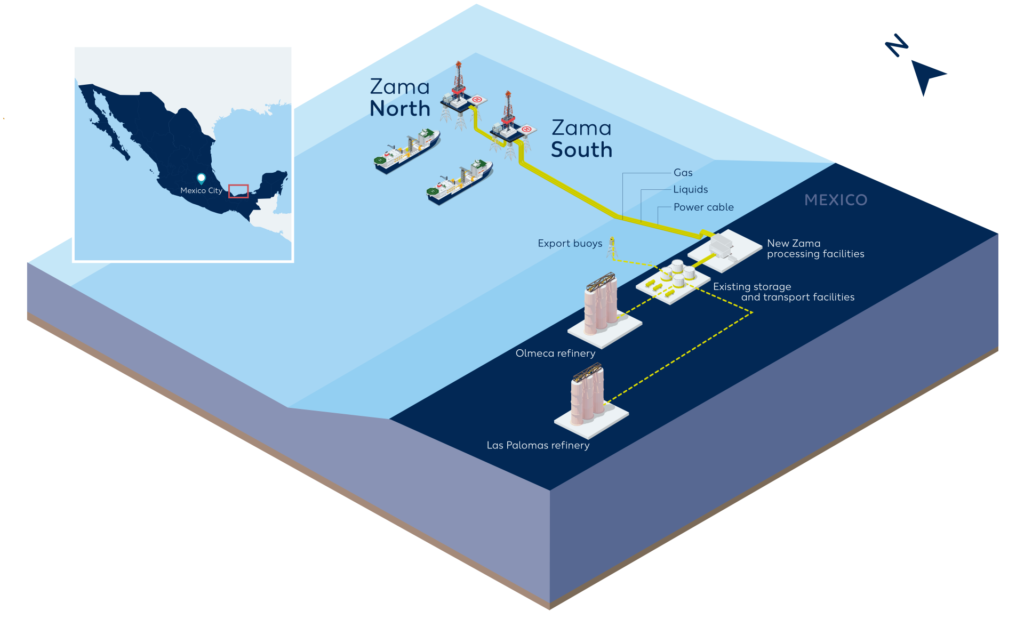
Talos’ focus area in Mexico is the Block 7, Zama Unit segment located within the Sureste (Southeast) Basin. Block 7 is a prolific proven hydrocarbon province in the shallow waters off the coast of Mexico’s Tabasco state.
Zama is classified as one of the world’s largest shallow water discoveries in the past 20 years. Both Mexico’s federal government and Pemex have granted the project as a “strategic project” owning to its production potential.
The Zama field, found in 2017, was the first field in Mexico found by consortium of IOCs. At the time, Houston-based Talos operated the project. As of yearend 2024, Pemex now operates Zama after being designated as operator by Mexico’s Energy Secretariat (Sener). Other partners in Zama include Harbour, Wintershall Dea and Mexico’s Grupo Carso, owned by Mexico’s wealthiest man Carlos Slim.
Initial production of up to 180,000 b/d could commence by 2030, according to estimates published independently by the consortium partners. Production is expected to be 94% oil of “excellent quality,” with API gravities between 26°-29° API, according to Talos.
The Block 7 consortium partners could take FID for Zama sometime in 2025, various independent consultants tell Energy Analytics Institute.
____________________
By Pietro D. Pitts with reporting from Houston and Mexico City. © 2024 Energy Analytics Institute (EAI). All Rights Reserved.


