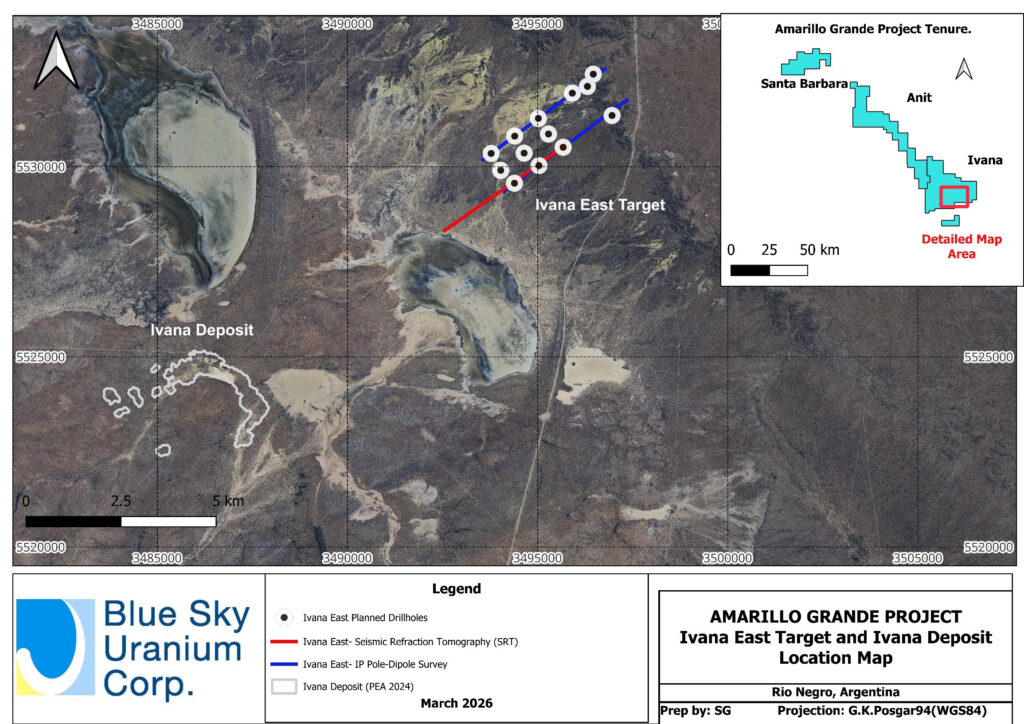
VANCOUVER, BC (By Blue Sky, 7.Apr.2026, Words: 711) — Blue Sky Uranium Corp. and its joint-venture operating company, Ivana Minerales S.A. (IMSA), announced commencement of a new 1,200 metre diamond drilling (DDH) exploration program at the Ivana East target, located approximately 10km northeast of the Ivana uranium-vanadium deposit within the company’s flagship Amarillo Grande project in Rio Negro province, Argentina (see Figure 1 below).
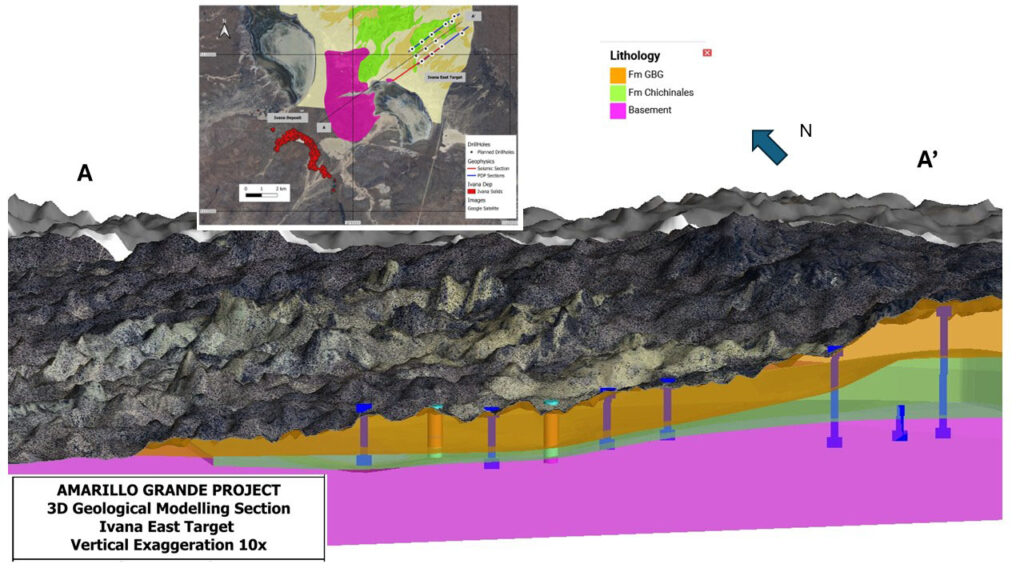
Geological interpretation indicates that the prospective Chichinales formation, identified as the host unit at the Ivana deposit, extends toward Ivana East. Despite the partial exposure of basement rocks between the two areas, Ivana East preserves the key geological conditions associated with uranium mineralization in the district (see Figure 2 below).
This program represents the first systematic drill testing at Ivana East under the company’s joint venture with a subsidiary of Corporación América Group (COAM) and is part of Blue Sky’s strategy to expand beyond the Ivana deposit and unlock additional value across the district-scale Amarillo Grande Project.
Nikolaos Cacos, Blue Sky president & CEO commented, “The start of drilling at Ivana East is a key milestone as we continue to explore the broader potential of the Amarillo Grande district. With the support of our JV partner, we are advancing and testing a pipeline of high-quality targets that share important geological characteristics with the Ivana deposit and offer compelling discovery potential close to a well-advanced asset.”
The company has recently completed a diamond drilling program at the Ivana Gateway target, located within the same district. A total of 1,188.5m was drilled, with the final hole completed in late Feb. 2026. The drilling contractor has since been mobilized to Ivana East, supporting the continued advancement of exploration activities across the Amarillo Grande project. Final assay results from the Ivana Gateway program are expected by the end of Apr. 2026.
Ivana East Target Overview
Ivana East has evolved into a compelling exploration target through the integration of historical datasets and modern geological interpretation. The target was initially identified by airborne radiometric surveys and advanced through follow-up work including surface radiometry, auger drilling and geophysical surveys, ultimately reaching the drill-ready stage. An initial reverse circulation (“RC”) drilling program was launched at Ivana East in 2023 however the program was suspended due to equipment issues.
Building on the successful development of the Ivana deposit model, the company now interprets Ivana East as a priority target within the same broader geological framework. The exploration concept is based on the continuation of the prospective Chichinales formation host horizon, where permeable sandstones and conglomerates occur near the basement unconformity — conditions known to host uranium mineralization at Ivana. Between the Ivana deposit and Ivana East, erosion is interpreted to have removed portions of the sedimentary sequence, leaving basement rocks exposed over much of the intervening area. Nevertheless, the preserved geological framework supports the potential for mineralization within favourable horizons at shallow depth.
The target is defined by several key elements that are also observed at the Ivana deposit: shallow depths to prospective horizons (approximately 10m–30m), favorable geological architecture, and geophysical responses consistent with porous sedimentary units overlying basement rocks.
2026 Diamond Drilling Program
The 2026 program comprises an initial diamond drilling (DDH) campaign of up to approximately 1,200m, designed to test priority zones within the Ivana East target area.
The program includes a series of scout drillholes with an average depth of approximately 50m, targeting shallow uranium mineralization along the unconformity between the Chichinales Formation and the underlying basement rocks.
To further support a geological model, the program includes one and potentially 2, drillholes planned to be extended to depths of approximately 100m. These deeper holes are part of the same drill fence and designed to test unit continuity toward the east, where the basement surface is interpreted to occur at greater depth. The holes will provide information to refine the geological interpretations, identify key alteration patterns, and better define redox boundaries prior to follow-up drilling.
The use of diamond drilling will provide continuous core recovery, enabling detailed geological, structural, and alteration logging — critical inputs for refining the exploration model and guiding subsequent drilling phases. Figure 1 shows location of the initial set of holes at Ivana East, totaling approximately 850m of drilling. The location and execution of subsequent holes are contingent on results from the initial set.
____________________