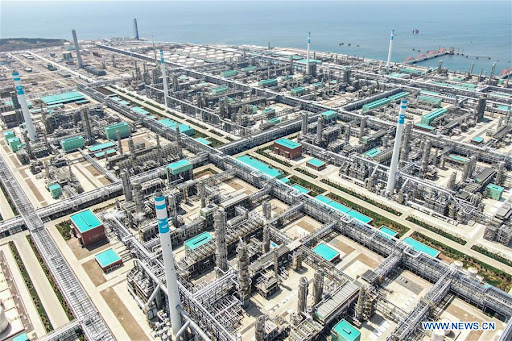
PANAMA CITY, PANAMA / HOUSTON, TEXAS (By Editors at Energy Analytics Institute, 9.Jun.2025, Words: 1,600) — Proposals for 6 new joint ventures (JVs) in Venezuela’s Orinoco heavy oil belt, or Faja, aimed to increase the South American country’s heavy and extra-heavy crude oil (EHCO) production capacity by an additional 2,090,000 barrels per day (b/d) or 2.1 MMb/d.
This potential was to add to the production potential from the 4 original upgraders build in the 1990s by international oil companies (IOCs): 3 from the US, 1 from the UK, 1 from Norway and 1 from France. At their peaks, these 4 projects were designed to produce 630,000 b/d of EHCO, which would be upgraded into 570,000 b/d of syncrude.
The 6 new upgraders that were proposed were part of a larger aim by Venezuela’s government, which always had an aim of boosting total oil production to around 6,000,000 b/d or 6 MMb/d. That plan was to be anchored by the Faja, which is home to an estimated 1,360 billion barrels or bn bbls, or 1.360 trillion or tn bbls, of original oil in place (OOIP) and is the largest such accumulation of heavy and EHCO in the world.
The Faja is divided into 4 primary areas: Junín, which contains 557 bn bbls; Boyacá, which contains 489 bn bbls; Carabobo, which contains 227 bn bbls; and Ayacucho, which contains 87 bn bbls. These 4 areas are further subdivided into 32 blocks for facilitation of quantification, certification, exploitation and development activities as such: Junín, with 12 blocks; Boyacá with 8 blocks; Carabobo, with 4 blocks; and Ayacucho with 8 blocks.
Successful development of the 6 projects was to seal the status of Venezuela’s state oil company Petróleos de Venezuela (PDVSA) as the dominate national oil company (NOC) in the Latin America and Caribbean (LAC) region owing to its planned majority shareholder in all the JVs in Venezuela.
On paper, the plan, laid out in the early 2010s, aimed to see Venezuela bring to market 10 upgraders to monetize its massive Faja resources. However, owning to mismanagement of oil rents, widespread political uncertainties that restricted IOCs from investing in Venezuela, the country’s oil sector hit a holding pattern for a number of years when production steadied around the 3,000,000 b/d (3 MMb/d) mark before starting its decline and then a complete collapse to around 337,000 b/d as recent as 2020 amid US oil sector sanctions under the first term of US president Donald Trump coupled with the negative economic effects of the Covid-19 pandemic, which reduced global demand for energy.
6 NEW PLANNED FAJA DEVELOPMENTS
The 6 new Faja JVs were to be developed between PDVSA and partners to include IOCs and NOCs. PDVSA, per the nationalization decree of 2007, was to maintain a controlling 60% interest in the JVs, which were to be composed of consortiums that would hold the remaining 40% interest.
The 6 projects where planned for the Carabobo and Junín blocks: 2 will be housed in the Carabobo block, and the remaining 4 in Junín, as summarized:
2 CARABOBO BLOCKS
In the easternmost Faja area of Carabobo, PDVSA aimed to develop the Petrocarabobo, S.A. and Petroindependencia, S.A. JVs, which held potential to add combined heavy oil production of 800,000 b/d as summarized:
Carabobo 1: Petrocarabobo
The Carabobo 1 block covers an area of 382.9 km2 and encompasses Carabobo 1 Central and Carabobo 1 North, which are located in the states of Anzoátegui and Monagas. Production potential from the block was estimated at 400,000 b/d.
The block was to be exploited by PDVSA (60% WI); Repsol Exploración, S.A. (11% WI); Petronas through its subsidiary PC Venezuela Ltd. (11%WI); ONGC Videsh Ltd. (OVL), through its affiliate Petrocarabobo Ganga B.V. (11% WI); and Oil Indian Ltd. (3.5% WI) and Indian Oil Corporation Ltd. (3.5% WI) through their affiliate Indoil Netherlands B.V. (combined 7% WI).
The upgrader associated with Petrocarabobo was to have capacity to produce 200,000 b/d-240,000 b/d and was to be located in eastern Venezuela (Soledad, Anzoátegui state). The upgrader would have processed EHCO of 8-9 degrees API, which would have been upgraded into a syncrude of 32-42 degrees API.
The upgrader was slated for completion in 2017, while estimated investments in Petrocarabobo were to approximate $11,170mn.
Carabobo 3: Petroindependencia
The Carabobo 3 block covers an area of 534.2 km2 and encompasses Carabobo 2 South, Carabobo 3 North and Carabobo 5, which are located in the states of Anzoátegui and Monagas. Production potential from the block was estimated at 400,000 b/d.
The block was to be exploited by PDVSA (60% WI); Chevron Carabobo Holdings APS (34% WI): Inpex Corporation (2.5% WI) and Mitsubishi Corporation (2.5% WI), through their affiliate Japan Carabobo UK Ltd. (combined 5% WI); and Venezuelan company Suelopetrol S.A.C.A. (1% WI).
The upgrader associated with Petroindependencia was to have capacity to produce 200,000 b/d-240,000 b/d and was to be located in eastern Venezuela (Soledad, Anzoátegui state). The upgrader would have processed EHCO of 8-9 degrees API, which would have been upgraded into a syncrude of 32-42 degrees API.
The upgrader was slated for completion in 2017, while estimated investments in Petroindependencia were to approximate $11,181mn.
4 JUNÍN BLOCKS
In the central-western Faja area of Junín, PDVSA aimed to develop the Petromacareo S.A., Petrourica S.A., Petrojunin S.A. and Petromiranda S.A. JVs, which held potential to add combined heavy oil production of 1,290,000 b/d as summarized:
Junín 2: Petromacareo
The Junín 2 block covers an area of 247.8 km2. Production potential from the block was estimated at 200,000 b/d, while the final destination for the block’s oil was Vietnam.
The block was to be exploited by PDVSA (60% WI) and Petrovietnam Exploration Production Corporation Ltd. (40% WI).
The upgrader associated with Petromacareo was to have a capacity to produce 200,000 b/d-240,000 b/d and was to be located in eastern Venezuela (Guárico state). The upgrader would have processed EHCO of 8-9 degrees API, which was to be converted into a syncrude of 32-42 degrees API.
The upgrader was slated for completion in 2016, while estimated investments, including drilling related expenses, development of infrastructure and upgrading activities, in Petromacareo were to approximate $3,899mn during 2016-2021.
Junín 4: Petrourica
Production potential from the Junín 4 Block was estimated at 400,000 b/d, while the final destination for the block’s oil was China. Most likely, portions of the oil would have also been destined to supply the Jie Yang refinery in the Guandong Province of China.
The block was to be exploited by PDVSA (60% WI) and China National Petroleum Corporation or CNPC E&D (40% WI).
The upgrader associated with Petrourica was to have capacity to produce 200,000 b/d-240,000 b/d and to be located in eastern Venezuela (Guárico state). The upgrader would have processed EHCO of 8-9 degrees API, which was to be converted into a syncrude of 32-42 degrees API.
The upgrader was slated for completion in 2016, while estimated investments in Petrourica were to approximate $3,850mn during 2016-2021.
Junín 5: Petrojunin
The Junín 5 block covers an area of 424 km2. Initial production from the block was expected to average 75,000 b/d of upgraded oil of 16 degrees API in 2013. However, production from the block was expected to reach 240,000 b/d by 2016.
The block was to be exploited by PDVSA (60% WI) and Eni Lasmo Plc (40% WI).
The upgrader associated with Petrojunin was to have capacity to produce 200,000 b/d-240,000 b/d and to be located in eastern Venezuela. The upgrader would have processed EHCO of 8-9 degrees API, which was to be converted into a syncrude of 32-42 degrees API.
The upgrader was slated for completion in 2017, estimated investments, including development activities, in Petrojunin were to approximate $10,850mn during 2016-2021.
Junín 6: Petromiranda
The Junín 6 block covers an area of 447.9 km2. Production potential from the block was estimated at 450,000 b/d in 2017.
The block was be exploited by PDVSA (60% WI) and a Russian consortium (40% WI) made up of Gazprom (8% WI), Lukoil (8% WI), TNK BP (8% WI), Surgutneftegaz (8% WI) and Rosneft (8% WI).
The upgrader associated with Petromiranda was to have capacity to produce 200,000 b/d-240,000 b/d and to be located in eastern Venezuela. The upgrader would have processed EHCO of 8-9 degrees API, which was to be converted into a syncrude of 32-42 degrees API.
The upgrader was slated for completion in 2020, while estimated investments in Petromiranda were to approximate $6,425mn during 2016-2021.
CONCLUSIONS
The 6 aforementioned heavy oil projects brought together 17 companies from 10 countries and would have required minimum estimated investments of $47,375mn to bring them to fruition. Completion of these projects would have allowed Venezuela to increase its heavy oil production by 2,090,000 b/d or 2.1 MMb/d, and would have also allowed Venezuela to increase the number of upgraders to 10, taking into consideration the 4 original ones – Sincor, Cerro Negro, Petrozuata and Hamaca – constructed and completed between 1998-2004.
Venezuela and PDVSA standed to benefit the most from continued developments in the Faja, where the bulk of Venezuela’s oil reserves are located. The Faja was expected to anchor future increases in heavy and EHCO production as Venezuela chased a long-time dream of getting to 6,000,000 b/d or 6 MMb/d.
While the projects held potential to increase revenues for PDVSA and the numerous partner companies, uncertainties lingered relating to permits, environmental impact studies, engineering issues, logistics, transport infrastructure, as well as ongoing changes announced by PDVSA and the Venezuelan government.
So, yes, a lost opportunity of maximum portions: operational, financial and economic.
____________________
By Editors at Energy Analytics Institute. © 2025 Energy Analytics Institute (EAI). All Rights Reserved.